


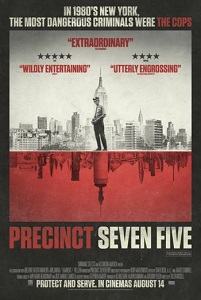
In Tiller Russell’s Precinct Seven Five (2014) we see how a small precinct in East New York became its most corrupt, as the boys in blue came to be on the payroll of local drug gangs. Michael Dowd and his partner Kenny Eurell were at the heart of it, and both could fit straight into a Scorsese film; this is no accident, since it is exactly how they would like to be perceived. Mikey D is jovial, unrepentant; like Lance Armstrong, he is even proud of the scale of his downfall. In the 90s his drug habits and wild behaviour echoed Abel Ferrara’s Bad Lieutenant (1992), but even when cocaine-addled and running lights around the ghetto in his red corvette he never feared being busted.
The result is like a cheap cop show, not something you’d choose to watch in the cinema. The documentaries vary greatly in quality, but there are minor parallels with Joshua Oppenheimer’s The Act of Killing (2012) here: the interviewees tie their own nooses with their hypocrisy. Michael Dowd says he considers himself “both a cop and a gangster.” All the corrupt cops carried out burglaries and beatings, protected and served drug gangs, and did who knows what else that they don’t care to admit to on camera. And yet they ooze vanity when talking about their codes and principles, even getting teary-eyed when they describe a fellow cop being killed – by one of the drug gangs. It is scarcely believable that they could be so short-sighted. As the story catches up with the present, Mikey D fixes the camera with his sincere, steady gaze and, blinking away the tears, fatalistically admits his “dreams were about being a good cop… sad it never happened.” There is little authorial perspective here from Tiller Russell, but then perhaps in such instances it is not really necessary.
